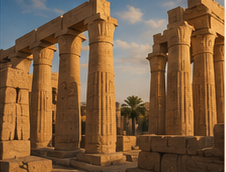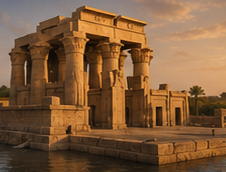
Kom Ombo sits directly on a bend of the river, which is the first thing that recommends it — you moor, and it is simply there, forty metres up the bank.
The second thing is that it is built twice. Run a line down the middle and everything doubles: two gateways, two colonnades, two sanctuaries. The southern half belongs to Sobek, the crocodile god; the northern half to Haroeris, Horus the Elder. Neither would tolerate the other's precinct, so the architects gave each a complete temple and joined them down the seam.
The reliefs people actually stop for
On the rear wall there is a panel usually described as a set of surgical instruments — forceps, scales, what may be a bone saw. How much of it is medical and how much is ritual equipment is argued about, but it is a genuinely strange thing to find on a temple wall.
Nearby is a calendar listing the festivals, and beside the entrance a nilometer — a well cut down to the river, used to read the height of the flood and set the year's taxes accordingly.
The crocodile museum next door holds mummified crocodiles recovered from the site. It takes fifteen minutes and it is worth them.