Most visitors reach Karnak at nine, when the coaches from the west bank have unloaded and the temperature is already climbing past thirty. I would rather you saw it at six-thirty.
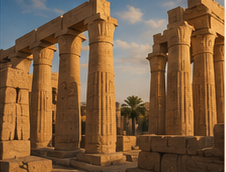
The reason is the Great Hypostyle Hall. Its hundred and thirty-four columns stand in sixteen rows, and the central twelve are taller than the rest — a deliberate step up in height that leaves a band of clerestory windows between the two roof levels. For roughly forty minutes after sunrise, light enters through that band at a low angle and lands in slabs on the column drums. The carving, which reads flat and grey under midday sun, suddenly has depth: you can see the difference between the raised relief of Seti I in the northern half and the sunk relief his son Ramesses II used in the south.
What to do with the hour
Walk the central axis first, from the first pylon straight through to the sanctuary, and do not stop for photographs. Getting the scale into your body before you start looking at detail is worth more than any single picture. Then double back to the northern columns and look for the Seti reliefs — you will not confuse the two styles again.
Afterwards, the sacred lake is a good place to sit while the site fills up. By eight the sound has changed completely, and that is the moment to leave.